
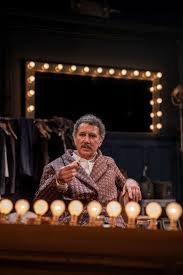
Seductive, melancholic and drenched in old-Hollywood allure, Love Omar blurs the line between fantasy and reality in a mesmerising meditation on celebrity mythology.
Review by Claire-Monique Martin
At Teatro Technis, Love Omar presents itself less as a historical retelling and more as a romanticised imagining — a meditation on celebrity mythology, longing, identity, and fantasy. What emerges is a production rich in atmosphere and intrigue, anchored by a mesmerising central performance from Al Nedjari as Omar Sharif himself.
From the moment the audience enters the space, the production’s strongest asset is immediately apparent: the staging and set design by Pip Terry. The world created onstage genuinely feels like Omar Sharif’s dressing room at Chichester Festival Theatre — intimate, glamorous, slightly melancholic, and filled with the ghosts of performance and ego. It is an immersive environment that allows the audience to sit within the mythology of the man before he even speaks.
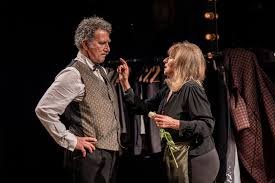
And when he does speak, Nedjari commands the room. His Omar Sharif is magnetic in a way that becomes increasingly complicated as the play unfolds. There are moments where his flirtatious charisma is utterly intoxicating, only for the audience to be jolted by the casual male dominance woven into both the culture and era being depicted. The production cleverly leaves viewers suspended between attraction and discomfort, forcing us to question why certain kinds of men — particularly celebrities — are so easily forgiven for behaviours we recognise as troubling. Nedjari balances this tension beautifully, never reducing Omar into either villain or fantasy.
Lara Sawalha delivers a compelling performance as Mag, though the character herself occasionally feels caught between too many competing ideas. Yet perhaps this confusion is intentional. Mag exists in a state of fractured identity: half Scottish, half Arab, unsure where she belongs socially, culturally, or emotionally. There is also a palpable jealousy within her relationship to Omar Sharif — not necessarily romantic jealousy, but envy towards the myth itself, the fact that he somehow lives up to his own legend. Sawalha navigates these contradictions with sensitivity even when the writing doesn’t always streamline them into one clear dramatic trajectory.
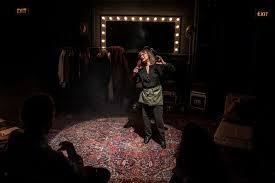
The production’s weaker elements largely come through its comedic framing, particularly in the handling of Daphne, played by Ishia Bennison. On paper, the character functions as a sharp comedic interruption to the emotional intensity of the play, and Bennison certainly commits to the energy required. However, too many of the comedic beats feel rhythmically identical throughout the evening, diminishing their impact over time. One particular scene, in which Omar forces Daphne to sing in order to embarrass her, stands out for the wrong reasons. Lip-syncing can absolutely work theatrically, but only when fully committed to stylistically. Here, the sequence feels oddly detached from the language of the rest of the production — especially because the play never again enters this kind of dreamlike theatricality. Rather than heightening the absurdity, the moment momentarily pulls the audience out of the world the production has carefully built.
Still, Love Omar remains consistently engaging because it understands the seductive danger of celebrity mythology. The script openly embraces fiction over strict reality, imagining emotional truths rather than historical accuracy. Modern ideas about race, identity, and power run through the piece, and while these occasionally clash with the glamour of the world being portrayed, they also give the production its tension. This is not a documentary portrait of Omar Sharif. It is an exploration of why figures like him continue to haunt the cultural imagination.
By the end of the evening, Love Omar leaves audiences wrestling with conflicting emotions — seduced by charm while simultaneously interrogating the systems that created it. Visually rich, atmospherically directed, and led by a truly captivating central performance, it is a production that lingers long after the curtain call.
Photo credit: Ellie Kurtz
Cast
- Al Nedjari — Omar
- Lara Sawalha — Mag
- Ishia Bennison — Daphne
Creatives
- Hannah Khalil — Writer / Playwright
- Chris White — Director
- Pip Terry — Designer
- Marty Langthorne — Lighting Designer
- John Nicholson — Movement Director
The production runs 7 May – 6 June 2026 at Theatro Technis in London