
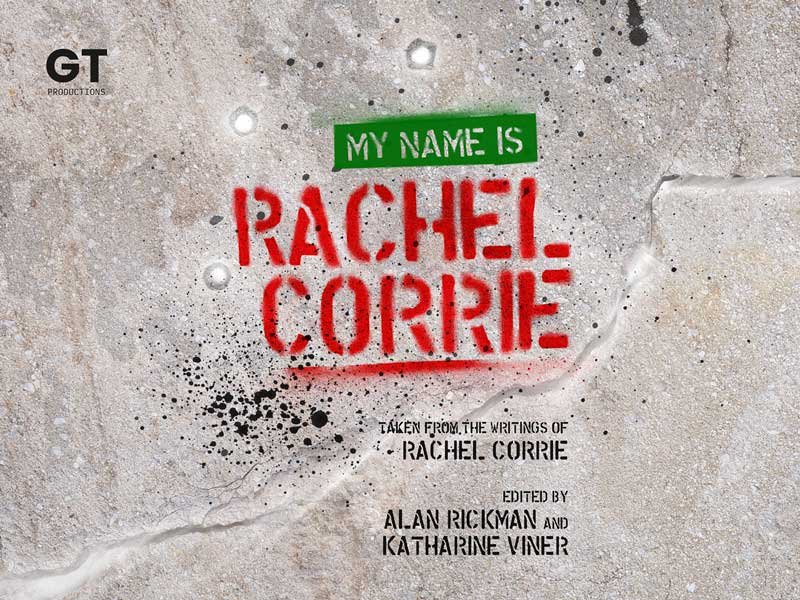
In March 2003, young American activist Rachel Corrie lost her life when she placed herself between an Israeli army bulldozer and a Palestinian home.
Composed from her own diaries and e-mails by Alan Rickman and Katharine Viner, this eloquent, moving and deeply personal play follows Rachel Corrie’s journey.
A collision of idealism, anger and wit, Rachel’s words are as relevant now as they have ever been.
For this major new production, Rachel Corrie will be played by Cassie Bradley (King Lear & Home, I’m Darling, National Theatre; Waterloo Road; Practical Magic 2).
Review by Stephen Gilchrist.
Critics have to be particularly careful when reviewing shows that are essentially a political polemic.’ My name is Rachel Corrie’ is such a play, a 90-minute performance in which an actress plays the activist Rachel Corrie who was killed by an Israeli soldier in a bulldozer in 2003. Her supporters claimed that she was deliberately mowed down and could be seen by the soldier driving the bulldozer although the Israeli Supreme Court, having heard the evidence, determined that it was in fact a tragic accident.
Rachel Corrie was a 23-year-old American from Washington state, a graduate, an aspiring poet and clearly a person who had strong views about particular issues. She travelled to Gaza to stand with other internationalists in support of Palestinians who she considered were being oppressed at that time by the Israeli state.
I have put aside my personal prejudices and biases and tried to look at this piece objectively. This is not a new play; in fact, it was first performed in 2006 and the text is taken from Rachel Corrie’s diaries and blogs and communications with her family as edited by Alan Rickman and Katherine Viner. It has been produced around the world many times and has now landed at the Greenwich Theatre Studio in London led by a performance of some power by Cassie Bradley.
One of the difficulties in reviewing this play [aside from trying to achieve an objective neutrality] is to determine whether you are in fact reviewing the play. or the character the play represents. The play itself is well put together under James Haddrel’s direction, the writing is elegant and indeed to some extent poetic. It presents a portrait of a young activist who is white, privileged and seeking a cause. I don’t say this with any disrespect to the late Ms Corie but the play represents a protagonist who is naive to some extent, and emotional, and of course it is one sided in reflecting the geopolitics of the time.
Many would say that in view of the current conflict in the Middle East this is the right time for resurrecting this piece of theatre. The difficulty is that geopolitics and history have moved on. In 2003, for example, Israel was on the cusp of handing over Gaza to a new Palestinian Authority to govern it. It gave Gaza back to the Palestinians totally in 2005 subsequent to which, I probably need not remind readers, Hamas staged a coup, won an election and for the next 20 years turned Gaza into a military tool with which to attack Israel, and of course we all know what happened on 7th October 2023 and subsequently.
And so, the representation in Ms Corrie’s eyes of innocent and peace-loving Palestinians is a perception which preceeds the election of a terrorist organisation by the populace. Likewise, the description of the Israeli military bulldozing greenhouses and shooting above the heads of Palestinians is without context and does not, obviously take into account, the fact that when Israel left Gaza all the greenhouses abandoned by Israeli settlers, were left standing as a benefit for the incoming Palestinian government which, in fact, destroyed by them.
I say all of this not to disparage the deeply felt feelings of the late Ms. Corrie nor her deeply felt views but maybe to suggest that what I have previously described as a political polemic can in fact date, and not necessarily well, in the light of subsequent events.
Ms Corrie was angry at the state of the world and looking forward to a future for herself although she was unclear as to what that future might hold. The text suggests that she foretold her own death and seems to have had issues with her parents. She seemed to enjoy making lists of things, possibly she was, as they say now,’ on the spectrum’ and somewhat, as only young people can be somewhat self-satisfied and self-indulgent in her own morality.
Cassie Bradley provided a first-class performance. When she cried you recognised the authenticity of her tears, when she was angry it was difficult to believe that she was just acting. It is a big part in every respect and she fills it potently and forcefully and draws the audience in.
The 2026 production at the Greenwich Theatre features set and costume design by Jana Lakatos. It is an intimate setting of a room surrounded by white brick, pictures postcards posters stuck to the walls, notes and correspondence dangling from the ceiling to which the performer refers and takes down one at a time. This is in many respects a confused and entangled life in which Ms Corrie tries to make sense of the world and herself.
I cannot fault Cassie Bradley’s performance or the impact that the piece had on many of the audience in a packed house. It is a significant play but one in which context is required to counterbalance its themes, and one which reflects a time past rather than a time present.



Cast
Cassie Bradley – Rachel Corrie
Creatives
James Haddrell – Director
Jana Lakatos – Set & Costume Design
Liv Baldock – Lighting Design
Amy Marsden – Scenic Artist
Ed Woodall – Movement Consultant
Tickets: click here