

Ensemble OrQuesta returns to Grimeborn with a revival of one of their most beloved productions, Dido and Aeneas.
One of the oldest and most enduring in the English repertoire, Purcell’s operatic masterpiece gets a strikingly intimate, minimalist treatment in Arcola’s downstairs studio.
Five performers bring to life a story of love, betrayal and abandonment that has moved audiences for over three centuries. Based on Virgil’s Aeneid, the opera follows the story of Dido, Queen of Carthage, who falls for the Trojan hero Aeneas, knowing he is destined to leave her.
Review by D.C Jackson
There is something inherently intriguing about a production of Dido and Aeneas that begins before the first note has even been sung. As the audience entered Studio 2, Marcio da Silva — director and Aeneas — handed each person a slip of paper asking them to choose who would play Dido and who would play the Sorceress that evening. It is a small but clever theatrical device, immediately giving the audience a sense of participation and curiosity about how the performance will unfold.
The concept is particularly interesting because both Helen May and Rosemary Carlton-Willis have rehearsed both roles. On the evening I attended, May played Dido while Carlton-Willis took on the Sorceress. Both were interesting to watch in their respective roles, and knowing that the performers could potentially swap characters adds another layer to the production. It would be fascinating to see the same staging with Carlton-Willis as Dido and May as the Sorceress, and to see how that change might subtly alter the dynamic of the piece.
According to the production notes, this is da Silva‘s sixth time staging Dido and Aeneas in this minimalist version. That experience is evident in the confidence of some of the production’s choices. With very little physical scenery, the production relies heavily on symbolism and the performers themselves to create its world. Some of these ideas are genuinely lovely. A simple piece of cloth becomes the sea, then a boat, before ultimately transforming into Dido’s funeral robes. It is an elegant piece of theatrical economy and one of the production’s strongest visual images.
However, I found myself wanting more from the use of the space. Studio 2 is a three-sided auditorium, and this presents both a challenge and an opportunity. With the audience surrounding the playing area, the staging almost demands to be conceived in the round, with the performers constantly considering all three sides. At times, however, too much of the action was directed towards the front, meaning that those seated to the sides could occasionally feel as though they were watching the back of a scene rather than being part of it.
This becomes particularly noticeable in a minimalist production. When there is little scenery to provide visual movement, choreography and spatial composition need to do much of that work. I would have liked to see greater ingenuity in how the performers travelled through the space, using diagonals, levels and the full circumference of the playing area to create a more immersive experience. There are clever ideas here, but not all of them are pushed far enough to create the impact they potentially could.
Where the production is unquestionably successful is musically. The instrumentation is beautiful, and there is a real richness and sensitivity to the musical performance. The vocals are also, at their best, extremely beautiful, and there is clearly considerable musical ability within the company.
The biggest obstacle is diction. Pronunciation and vocal clarity suffered at several points, and this is particularly problematic in Studio 2, a space with a tendency to absorb sound. In an opera where the text is so important to the storytelling, making sure every lyric reaches the audience should be a major priority.
This is perhaps the difference between an audience member who already knows Purcell‘s opera and one experiencing it for the first time. If you know and love Dido and Aeneas, there is much to appreciate here: the beautiful music, the quality of the instrumentation, the stripped-back aesthetic and the willingness to experiment with how the piece is presented. But if you do not know the opera, the inability to consistently understand the lyrics risks making the emotional journey considerably harder to follow.
And that is a shame, because Purcell‘s story is powerful enough to stand on its own: love, betrayal, abandonment and grief. The production has some genuinely interesting theatrical ideas, but I wanted those ideas to be communicated with greater clarity and to land with greater impact.
Ultimately, this is a production where I could see the ingenuity behind the concept, but I was left wishing for more ingenuity in its execution. The minimalist approach can be incredibly effective, and the cloth sequence is a beautiful example of how much can be achieved with very little. The next step would be to give the same level of thought to the choreography of the performers within the space and to the clarity of the text.
For those already familiar with Purcell, this will likely be a rewarding and musically accomplished interpretation. For newcomers, however, the production needs to make the story and words as accessible as the music. There is something compelling at its core — it simply needs a little more theatrical precision to make that potential truly resonate.
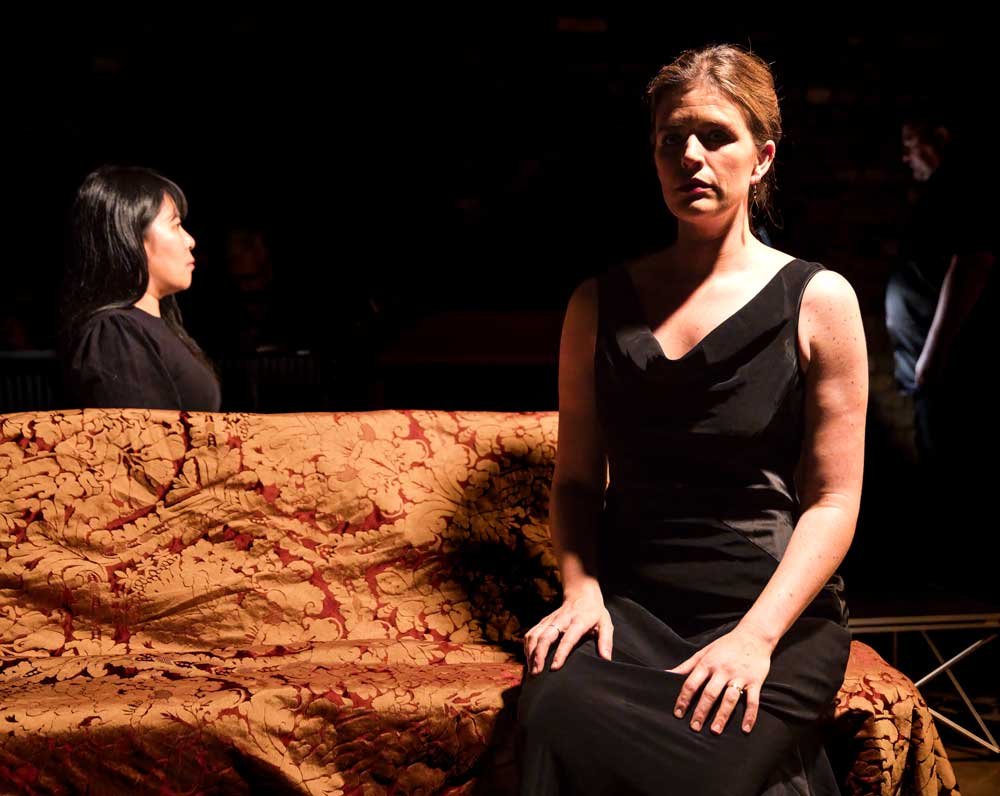
Dido and Aeneas — Grimeborn Opera Festival 2026, Arcola Theatre, Studio 2
11–15 August 2026, 7pm | Running time: 70 mins | Tickets: £20–£29
Music: Henry Purcell | Libretto: Nahum Tate | Director/Stage & Music Director: Marcio da Silva
Cast: Helen May, Rosemary Carlton-Willis, Marcio da Silva, Tara Venkatesan, Lydia Ward
Creatives: Marcio da Silva (Director/Stage & Music Director), Predrag Gosta (Co-Music Director/Harpsichord), Marjorie Lemos (Stage Manager)
Ensemble: Ensemble OrQuesta Baroque — Matthew Millkey, Sara Matovic (Violins), Hinki Suen (Viola), Pablo Tejedor-Gutierrez (Cello), Predrag Gosta (Harpsichord)
Ticket link: Click here