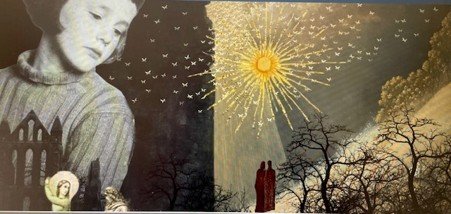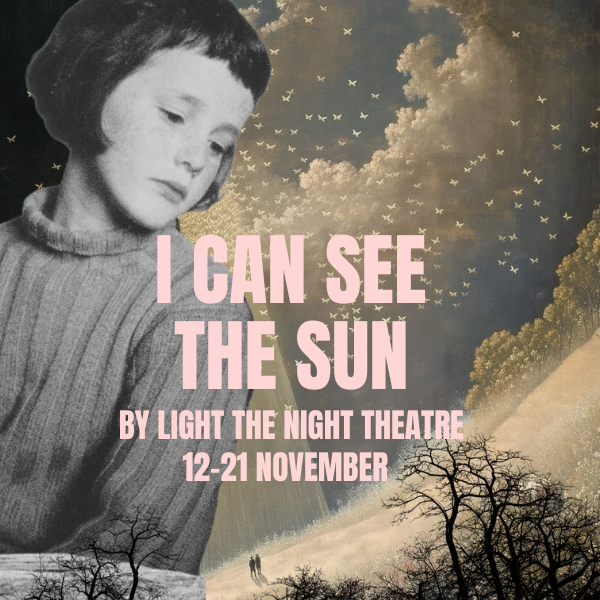
A surreal, darkly humorous drama inspired by Dante’s Divine Comedy.
After taking a wrong turn at Goole on the road back from IKEA, a mother and daughter become lost in the ‘Dark Wood’ on the North York Moors, when they stumble on a stranger in the dead of night. Is he a hunter out to steal hearts, or a moorland hiker who’s seen the light? Will they row across the river into deeper despair, or find the path to the car before sunrise?
Review by David Delve.
“Midway along the path of our Life” – Dante
We begin in the dark – literally – with two females lost and confused, but eventually emerging as a mother, Lucy, and daughter, Grace. They argue over taking the wrong turn out of Goole for Whitby, after a visit to IKEA! Now in a dark forest it soon becomes apparent this is not entirely realistic. Light comes at last, but neither finds a path…so we learn about them. Grace feels isolated, unloved, and unappreciated, whereas her mother feels misunderstood, and beleaguered by Grace. Blame falls on Grace’s unloving marriage and child-caring. Grace is bitter over the lack of a mother’s love and interest. They squabble. Quotes of Dante’s “Divine Comedy” (1307) are interspersed with references to the moon, the stars, the river, and the journey he takes through Hell, Purgatory, and finally Paradise. So, we are in an Allegory! When a man in black balaclava, with large black bag arrives on their forest clearing, they turn into mercenaries beating, bagging, and tying him up, without a ‘by your leave’. Once allowed to speak Noah calls himself The Messenger. Mother takes his iPhone light to find the path to her car, leaving him with Grace to enjoy the stars and satellites in the Blood moon (lunar eclipse), and its ancient mysteries – before he walks on over the moors to a Goth gig in Whitby, and scatter his wise grandfather’s ashes. When Lucy returns the rain falls – the trio build a shelter from random branches, and whilst under it Noah strums his guitar (from his bag), and singing with Grace : ‘We are Titanium’. As day breaks and the sun rises so do the characters’ restrictions. Lucy, in a glitter top, feels reborn, and searches out the car, leaving behind Grace, and her worldly chattles in the IKEA bag. Grace joins with Noah to be enveloped in sunshine. So is Paradise reached? Questionably!
The story is patchy, and not really helped by music, and a pop song. The characters are clearly defined in performances from Tania Khan (writer, director & Grace), Karen Cass (Lucy), and Ethan Dillon (Noah) – the latter having the clearest delivery, whereas the ladies lose volume by mumbling at times, and so energy for the piece. A clear simple set (Alice Edgar) of a section of heathland, with a backdrop of video’d woods (Jessica Brauner).
This allegory attempts to bring two irritating, uptight women to reasonable awareness. It doesn’t quite achieve this. Some rewriting, and tightening would help to reach: “The Love that moves the sun and other stars “– Dante
Cast
Karen Cass – Lucy
Ethan Dillon – Noah
Tania Khan – Grace
Creatives
Tania Khan – Writer and Director
Hope Wishart – Associate Director
Alice Edgar – Design Consultant
Catalina Diaconescu – Stage Manager
Cian Feasey – Lighting Designer
Jessica Brauner – Videographer
The production was developed with support from ArcolaLAB.
The Hope Theatre, Islington
12–21 November 2026
Produced by Light The Night Theatre