
Written by Paul Bradshaw, the two plays offer a witty and candid look at queer life in contemporary London. tell me straight follows a man attempting a 30-day detox from alcohol, fast food and sex after a string of hook-ups with straight men, while aggy explores race, gender and privilege as a couple experiment with creating an alter ego to help one partner advance his creative career. Together, the plays explore the ways we shape and perform our identities in relationships, work and wider society, moving between humour, tenderness and darker questions around authenticity and ambition.
Review by Richard Lambert.
The Production: Tell Me Straight
Having finally taken our seats, the play began. Unfortunately, the production itself did little to compensate for the evening that preceded it.
Tell Me Straight is not a new play. It has already appeared at the King’s Head Theatre, Hope Mill Theatre, Turbine Theatre and Chiswick Playhouse between 2021 and 2022, before returning to the Park Theatre in March 2026 and now the King’s Head Theatre in October and November 2026.
The production has also received support through Ian McKellen’s ATG Producers Grant for the 2026 Park Theatre production. Arts Council England funding has been associated with Paul Bradshaw’s wider work, including writing workshops for queer and working-class artists.
Paul Bradshaw not only wrote Tell Me Straight but also performs in it. He remains on stage throughout in a single costume, while his co-actor takes on multiple roles, distinguished largely by changing tops. The result, for me, is a production that feels pedestrian in both its writing and execution.
The direction and staging offer little visual interest. A chair or two appears when required and is then returned to its position upstage against the back wall. The backdrop seems largely disconnected from the locations or situations being portrayed. Much of what we see consists of the two performers sitting on stage or walking around one another. Rather than revealing much about the characters or their relationships, the staging occasionally feels like a drama school examination designed to demonstrate an understanding of power dynamics in stagecraft.
There may well be an intention behind this minimalism, but I found the overall effect dramatically flat. The production lacks the visual imagination, theatrical invention and momentum that might have lifted the material beyond its rather pedestrian presentation.
When I saw this play at the Tabard many years ago it was a lot more fun, entertaining and believable. The lack of chemistry here wasn’t what I remember from the Tabard production.
I also found the central premise somewhat uncomfortable. The story of a gay man’s desire for a straight man is hardly new, but in 2026 it feels like well-trodden territory. I found myself questioning what this particular dynamic has to say to a contemporary audience, beyond the familiar pain of unrequited desire. For me, it felt less like a fresh exploration of sexuality and relationships and more like a story we have heard before. Maybe the Arts Council still find this topical.
I should make clear that these are criticisms of the play and its staging, not of the venue. The delayed start, poor communication and uncomfortable audience arrangements undoubtedly affected my evening, but they are separate issues from my response to the production itself. Even allowing for the frustrations beforehand, I found the play insufficiently engaging to persuade me to stay beyond the interval.
I had not expected to leave at the interval, but by that point I was ready to go home to my dog.
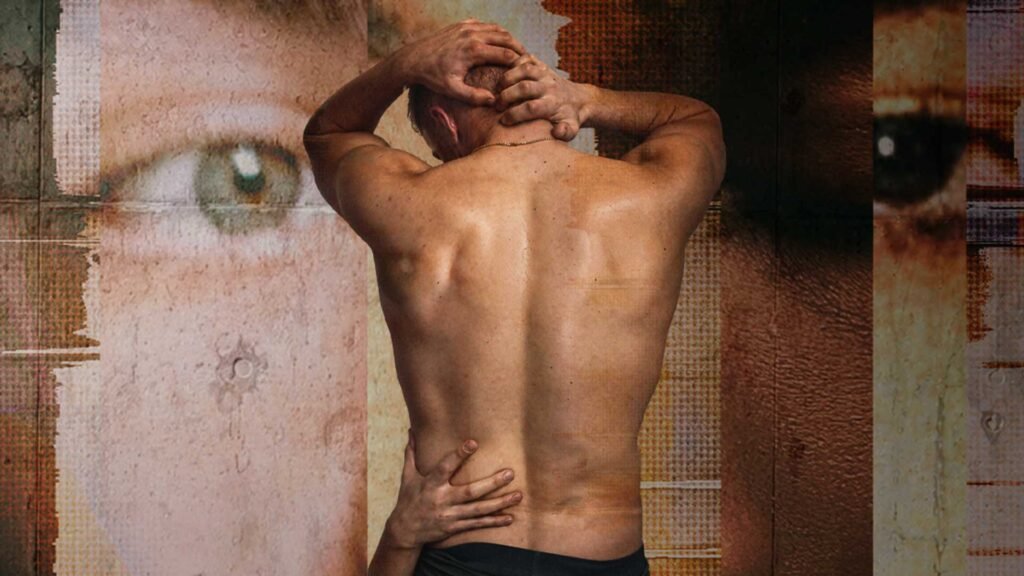
I was also uncomfortable with the use of sexually charged promotional imagery. The advertising image implies a shirtless man being serviced by another man on his knees, creating a particular expectation about the show’s content. Nothing of that nature was evident in the portion of the production I saw. Promotional material should generate interest, but it should also give audiences a fair indication of what they are buying a ticket to see.
It is worth acknowledging that my response was not necessarily shared by everyone. My impression was that the audience appeared to enjoy the show, and subsequent reviews have been very positive. Clearly, the production has found an audience, even if it did not work for me.
Ultimately, I found Tell Me Straight a rather pedestrian theatrical experience. That judgement stands independently of the venue’s failings on the night. One is a criticism of the production; the other is a criticism of how the audience was treated. Both deserve to be considered on their own merits. My rating of 1 Star is for the play and not the venue.
The Venue Experience: An Uncomfortable Evening Before the Curtain Even Rose
For me, the theatre experience begins the moment you arrive, and unfortunately, on this occasion, it started a bit dodgy and went downhill from there.
The evening began promisingly enough. The press desk was outside, where I was greeted by the PR company and handed a card with my name and handwritten seat number, along with a drinks voucher. A lovely welcome. Sadly, things deteriorated rapidly once I moved towards the theatre itself.
I showed my card at the door and was directed towards the Box Office, only to be told, after waiting to be served, that I didn’t need to be there and could enter. I then descended two flights of stairs to level -1, where the bar queue blocked the bottom of the stairs and rounded the corner. I had to apologise to people as I squeezed through to join the queue, and by the time I reached the bar, I was also obstructing those trying to enter the venue.
Having collected my drink, I continued down another six flights of stairs to level -4, where the audience was waiting for the house to open. Showtime came and went, but there was no announcement, no apology and no indication of what was happening.
In these circumstances, the usual procedure is straightforward: acknowledge the delay, apologise to the waiting audience and provide an update. Audiences are generally understanding. After all, this is live theatre, and things can go wrong. What they are less likely to appreciate is being left in the dark.
I asked when the house would open and was told, “Don’t know.” I asked again and was informed there were “technical difficulties”. Over the next 45 minutes, I approached two further members of staff who were communicating over radios, only to receive exactly the same response. It was frustrating, particularly when the explanation seemed to be little more than a convenient way of blaming the technical team. Whatever the actual problem, the audience deserved honest communication.
Eventually, the difficulties were apparently resolved, and we entered the auditorium around 20 minutes after the advertised start time. The house-opening process then proceeded at an extraordinary pace, with the audience being admitted two by two over another 20 minutes. The performance finally began approximately 40 minutes late, after the audience had spent around an hour standing shoulder to shoulder in a cramped holding area.
For anyone with mobility difficulties or health conditions, this was more than an inconvenience. Standing for that length of time, with little room to move and staff continually pushing past, was uncomfortable and, in my case, painful. You felt as though you were in everyone’s way, largely because the space and arrangements made that almost inevitable.
I fully appreciate that press nights can present challenges, and technical problems are part of live performance. But leaving around 140 people standing in a confined space for an hour without meaningful communication is not acceptable audience management. The whole experience felt like a Ryanair nightmare flight, with nobody apparently in charge and nobody prepared to explain what was happening.
It is difficult not to wonder whether the venue’s current management situation has contributed to this. The theatre is recruiting for an Artistic Director and Chief Executive following the departure of its previous Chief Executive in June 2026. I hope the venue can maintain its standards, and ideally improve them, until its new leadership is in place in spring 2027. Whatever the circumstances behind the scenes, the audience experience needs to remain a priority. If I were to rate the venue, at the moment it would also be a 1 Star.
Cast
Paul Bradshaw – Him
Elliott Rogers – Matt / Ryan / Lee
Matthew Jordan – Lawrence
Jean-Luke Worrell – Mahlik
Jack Grittins – Rex
Jade Anouka – Dani (voiceover)
Creatives
Paul Bradshaw – Writer & Co-Director
Imogen Frances – Co-Director & Intimacy Director
SH Productions – Producer
Damien Stanton – Set & Costume Designer
Cheng Keng – Lighting Designer
Eamonn O’Dwyer – Sound Designer
Matt Powell – Video Designer
Alice O’Hanlon – Movement Director
Georgie Rankcom – Dramaturg (aggy only)
Zoë Birkbeck – Rehearsal Photographer
Anna Eagle – TSM
Lauren Dalboth – Stage Manager
Tickets: Click here