

Based on Wladyslaw Szpilman‘s extraordinary internationally bestselling memoir, this landmark new production, adapted and directed by the acclaimed Thom Southerland (Titanic the Musical), brings one of the twentieth century’s most remarkable true stories to the stage featuring Szpilman’s own music for the very first time.
Original compositions from the so-called ‘Polish Gershwin’ score his story: popular songs that had Warsaw humming, compositions that made him a star, all given rich new life in orchestrations by Simon Lee, Andrew Lloyd Webber’s long-time musical director.
Review by Stephen Gilchrist.
Describing this powerful true story about a Holocaust survivor as ‘A New Musical’ is a bit like marketing ‘Schindler’s List’ as ‘A War Film’, or ‘The Magic Flute’ as a musical comedy. The denomination, ‘A New Musical’, trivialises the narrative, the text and indeed much of the music. Apart from which, it is not what you would call ‘a musical’. There are ‘musical comedies’, ‘musical dramas’, musical plays, works of ‘musical theatre’ and plays with music.
The Pianist does not easily fall into any of these categories which is one of the reasons it is an exceptionally interesting piece. When you write ‘musicals’ about catastrophic world events you have to be very careful indeed. I once tried to produce an American musical play based on the Diary of Anne Frank. It played very successfully in Manchester but we couldn’t get it to London. That, and this play, The Pianist is about the Holocaust, but it is not ‘Springtime for Hitler’.
The Pianist is based on the 1946 memoire written by Wladislaw Szpilman, a highly thought of Polish Jewish pianist, classical composer and Holocaust survivor. Szpilman is widely known as the central figure in the multi award winning Roman Polanski film ‘The Pianist’, which was based on his autobiographical account of how he survived the German occupation of Warsaw and the Warsaw Uprising and in which Adrian Brody famously played Szpilman.
The play is both adapted and directed by the talented Thom Southerland who has previously directed excellent versions of Maurey Yeston’s Titanic, Ragtime and others. I recently saw his first-class revival of ‘Noel and Gertie’ in Southampton. You may take it therefore that he knows what he is doing in ‘musical theatre’.
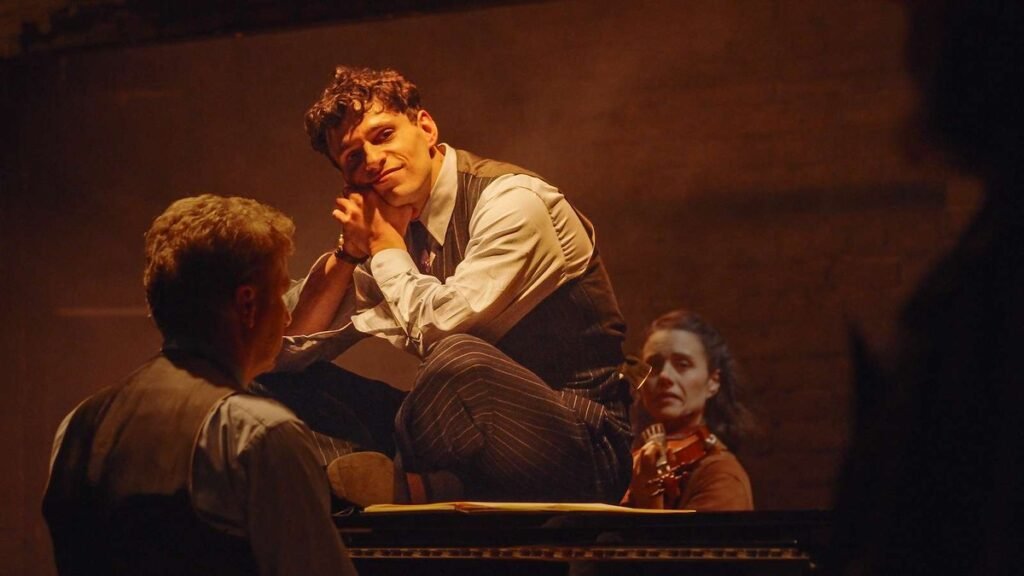
The story is told as a recollection in first person terms by Szpilman, played in an empathetic, understated manner by Daniel Krikler, not dissimilar to Brody’s depiction, interacting with his co-actor/musicians in dramatized scenes from his life. He and his family lived in Warsaw, were trapped in the ghetto, and when his family were finally transported to the ‘final solution’, he, through good luck, happenstance, or maybe, destiny, escaped and managed to scrape hungrily and impoverished through the rest of war, latterly with the help of a sympathetic German soldier, Wilm Hosenfeld, a German officer who detested Nazi policies.
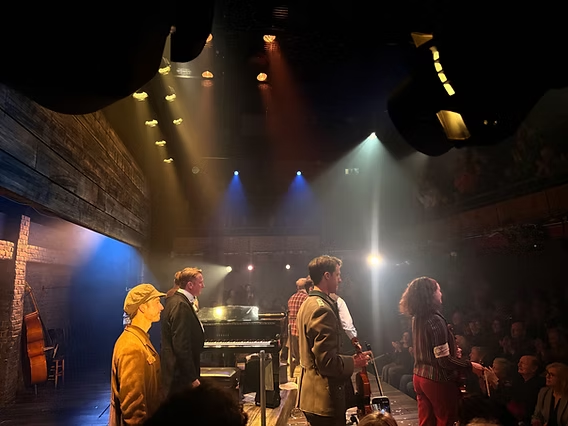
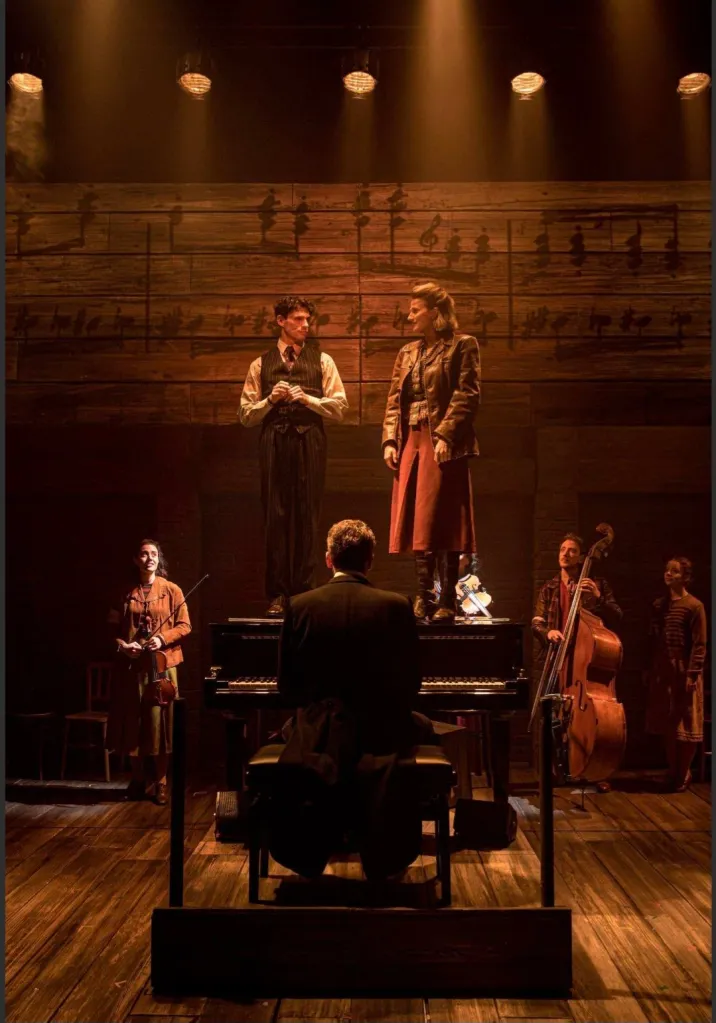
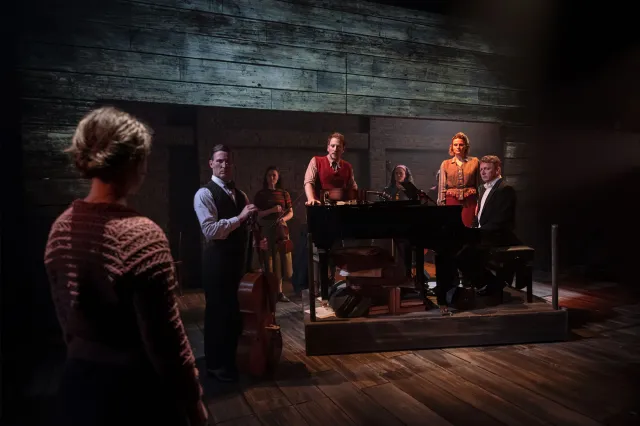
It is a powerful story set against strikingly stark settings by Andrzej Goulding, lit by Robbie Butler, which both represent the walls of the ghetto and the closing doors of the cattle trucks taking Szpilman’s family to oblivion.
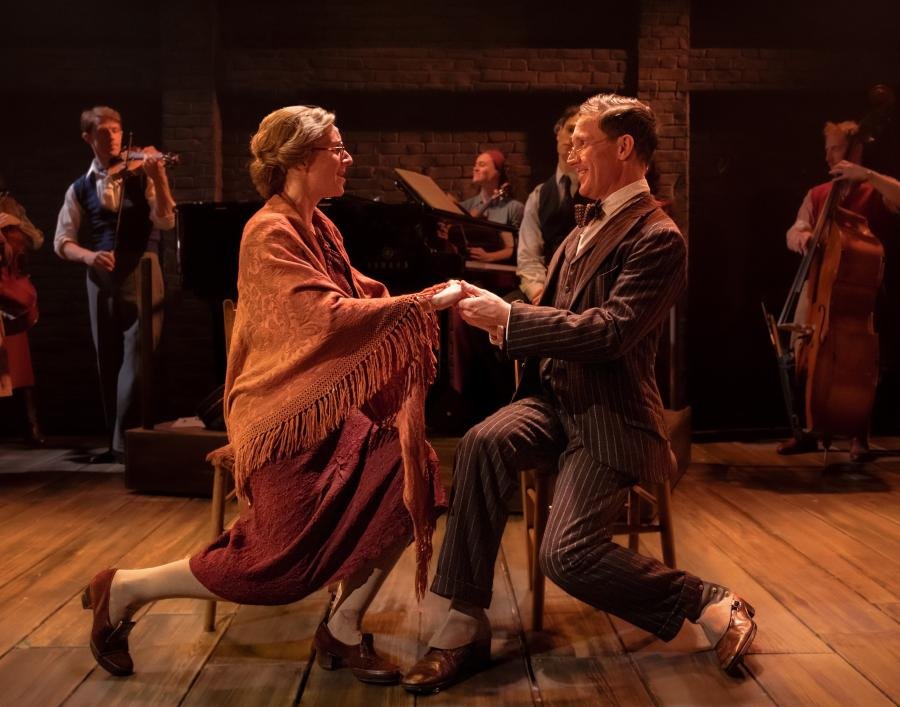
The action is punctuated by Szpilman’s compositions, some of them instrumental. He was often called the ‘Polish Gershwin’ a celebrated radio and concert pianist in pre-war Warsaw who wrote popular songs and jazz-influenced compositions that made him a star. In the first act especially, his lilting popular melodies with lyrics contributed by a number of different lyricists are delivered by the excellent twelve strong company of actor/singer/musicians. They are not merely ensemble. They each play characters in the story, primarily Szpilman’s family and principally, his father (T.J Holmes who also plays cello), too blind to see the Nazi threat, and his firebrand brother Henryk (Nitai Levi, outstanding). His mother is played by Rosalind Ford with sensitivity. There is little room for dance band songs in Act 2 as Szpilman shivers and starves alone in a series of bare rooms in Warsaw, thus most of the music is instrumental ending with a song ‘Out of the Darkness’.
The whole production is delivered with love and care. The performers are elegantly moved around in musical staging by Karen Bruce and central to the whole is a grand piano, played, by way of ghosting Szpilman, by the excellent Musical Director, Malcolm Forbes-Peckham under Simon Lee’s arrangements and musical supervision, and costumed throughout in white tie and tails.
So how would I describe this show? Is it a ‘New Musical’? Not really. The music doesn’t drive the narrative, it creates mood, atmosphere and ambience but is no less significant to the overall tone of the drama because of that.
There is a barrelful of creatives credited in the programme and there is already a ‘World Premiere Recording’ suggesting the producers have high aspirations for this striking piece of work. It is, in many ways, a remarkable piece of theatre exceptionally well told which I predict will have a very bright future.
Cast — The Pianist, Park Theatre
Daniel Krikler — Władysław Szpilman
Malcolm Forbes-Peckham — Pianist
Rosalind Ford — Mother
Oliver Grant — Hosenfeld
TJ Holmes — Father
Mischa Jardine — Janina
Elżbieta Kalicka — Regina
Nitai Levi — Henryk
Melania Maggiore — Halina
Max Roll — Gimpel/Majorek
Oliver Magor — Ensemble
Erin Rowlatt — Ensemble
Creatives
Władysław Szpilman — Book and Music
Thom Southerland — Adaptor and Director
Simon Lee — Arrangements, Musical Supervision and Orchestrations
David Batteau — Lyricist
Carol Connors — Lyricist
Marcy Heisler — Lyricist
Wendy Lands and Jim Gillard — Lyricists
Michael Ruff — Lyricist
Andreas Szpilman — Lyricist
Arthur Schlosser (aka Dean Dobbins) — Lyricist
Karen Bruce — Choreographer and Movement Director
Andrzej Goulding — Set and Video Designer
Robbie Butler — Lighting Designer
Gareth Tucker (Autograph Sound) — Sound Designer
Jonathan Lipman — Costume Designer
Malcolm Forbes-Peckham — Musical Director and Copyist
Josh Whatsize — Assistant Director
Ginny Schiller CDG — Casting Director
Ben Armstrong — Casting Assistant
Wolk Transfer Company — Producer
DEM Productions — Executive Producer and General Manager
Simon Batho — Company Stage Manager
Jasmin Davies — Deputy Stage Manager
Antonia Howlett — Assistant Stage Manager and Book Cover
Angus Wu — Sound No. 1
Theo Foley — Sound No. 2
Grace Douetil — Head of Wardrobe
Federica Romano — Costume Supervisor
Giles Deacon — Cover Musical Director
Campbell Young Associates — Hair, Wigs and Make-up
Further information and tickets: click here